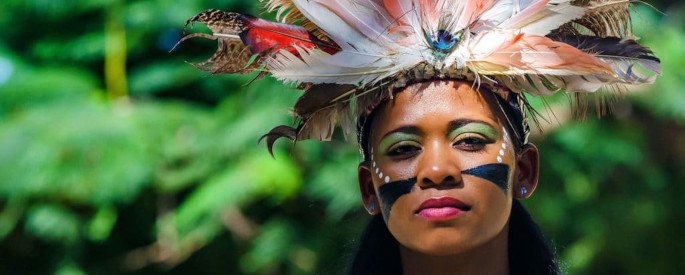
Long before the Dominican Republic had its name, cities, roads, and modern towns, the island of Hispaniola was home to the Taínos, an Indigenous people whose culture, traditions, and way of life are still part of the story of the Dominican Republic today.
The Taínos lived throughout Hispaniola, which they called Ayiti or Quisqueya, and built communities centered around farming, fishing, hunting, trade, and family life. They developed a rich culture with their own language, spiritual beliefs, music, art, and traditions. Many aspects of their daily life were closely connected to the land and sea around them.
Life in Taíno communities
Taíno communities were organized into villages called yucayeques. A village could have many families living together, with homes made from materials such as wood, palm leaves, and other plants found on the island.
The main crops included yuca, or cassava, which was one of the most important foods in their diet. They also grew sweet potatoes, corn, beans, squash, and other crops. Yuca was particularly important because it could be turned into casabe, a flat, crisp bread that is still eaten in the Dominican Republic today.
The Taínos also fished in the rivers and surrounding waters and hunted animals found on the island. Their knowledge of the environment allowed them to make use of the plants, trees, rivers, and coastline around their communities.
The Taíno language
The Taínos spoke a language that influenced the Spanish spoken in the Caribbean. Even though the Taíno language is no longer spoken as a living language, many Taíno words became part of everyday vocabulary.
Words such as hamaca, barbacoa, canoa, huracán, and tabaco have Taíno origins. In the Dominican Republic, you can still see this Indigenous influence in place names, foods, and words used in everyday life.
This is one reason Taíno history is not simply something that happened hundreds of years ago. Pieces of the culture remain part of the language and traditions of the island.
Their connection to yuca and casabe
One of the strongest examples of Taíno influence that remains in Dominican life is casabe.
The Taínos learned how to process yuca and turn it into a flat bread that could be stored for long periods. This was especially useful in a tropical environment where food preservation was important.
Today, casabe is still part of Dominican cuisine, especially in rural areas and during traditional meals. It can be eaten alongside meats, soups, and other foods, and some families still have strong connections to the traditional ways of preparing it.
Taíno beliefs and spirituality
The Taínos had their own spiritual traditions and believed in a world filled with spirits and supernatural forces. Their religious practices were connected to nature, ancestors, and beings known as zemí.
Zemí could represent spirits, gods, ancestors, or other sacred forces. Taíno people created carved figures and objects representing these spiritual beings, some of which have survived and can be seen in museums and archaeological collections today.
Ceremonies, music, dancing, and storytelling were important parts of Taíno society. Their beliefs were closely connected to their understanding of nature and the world around them.
The arrival of Christopher Columbus
In 1492, Christopher Columbus arrived on the island during his first voyage across the Atlantic. At the time, Hispaniola was home to a large Taíno population and was divided into several chiefdoms, each led by a cacique, or chief.
The arrival of the Spanish changed life on the island dramatically.
The Taínos faced forced labor, violence, displacement, and diseases brought by Europeans. Their population declined rapidly during the decades following European arrival.
This part of Taíno history is important because it is sometimes simplified into the idea that the Taínos simply disappeared. The reality is more complicated. Many Indigenous people died from disease, violence, and harsh conditions, while others survived, moved into different communities, and became part of the mixed population that developed on the island.
The Taínos are still part of Dominican history
For many years, Taíno history was treated as though it belonged entirely to the distant past. Today, there is much more interest in understanding the Taínos as a living part of Dominican heritage.
Their influence can be seen in Dominican food, language, place names, archaeological sites, traditional objects, and cultural practices.
The Dominican Republic also has important archaeological sites where researchers have found evidence of Taíno communities, including pottery, tools, carvings, and other objects that help tell the story of Indigenous life on the island.
What happened to the Taínos?
The Taíno population suffered an enormous decline after European colonization, and there is no simple date when the Taínos “disappeared.” Indigenous people survived, and their descendants became part of the populations that developed throughout the Caribbean.
This history is especially important when talking about Dominican identity. Dominican culture was shaped over centuries by Indigenous Taíno people, Africans, Europeans, and later groups who came to the island. The result is a culture that cannot be traced to one single origin.
Learning about the Taínos helps put that history into perspective.
When you eat casabe, hear a Taíno-derived word, visit an archaeological site, or see Indigenous symbols represented in Dominican culture, you are seeing pieces of a much older story. The Taínos were not simply people who lived on the island before the Dominican Republic existed. They were an important part of the foundation of its history and culture.