There’s no posted schedule, no app telling you when the next vehicle is coming, and sometimes not even a visible route number. Yet somehow, Dominican public transportation moves millions of people every day.
At first, it can look completely chaotic. Guaguas stop wherever someone is waiting, cars pull over to pick up passengers, and a motoconcho can appear out of nowhere when you are trying to figure out how to get somewhere. But once you understand how everything works, there is actually a system to it.
You just have to learn the unwritten rules.
For visitors, public transportation can also be one of the best ways to see a side of the Dominican Republic that you will not necessarily experience from a resort shuttle or private taxi. You will be sharing the ride with locals, seeing the neighborhoods between tourist areas, and getting a much better sense of how people actually move around the country.
Here are the main types of transportation you will encounter.
Guaguas
Guaguas are one of the most common ways to travel around the Dominican Republic, especially between smaller towns and cities.
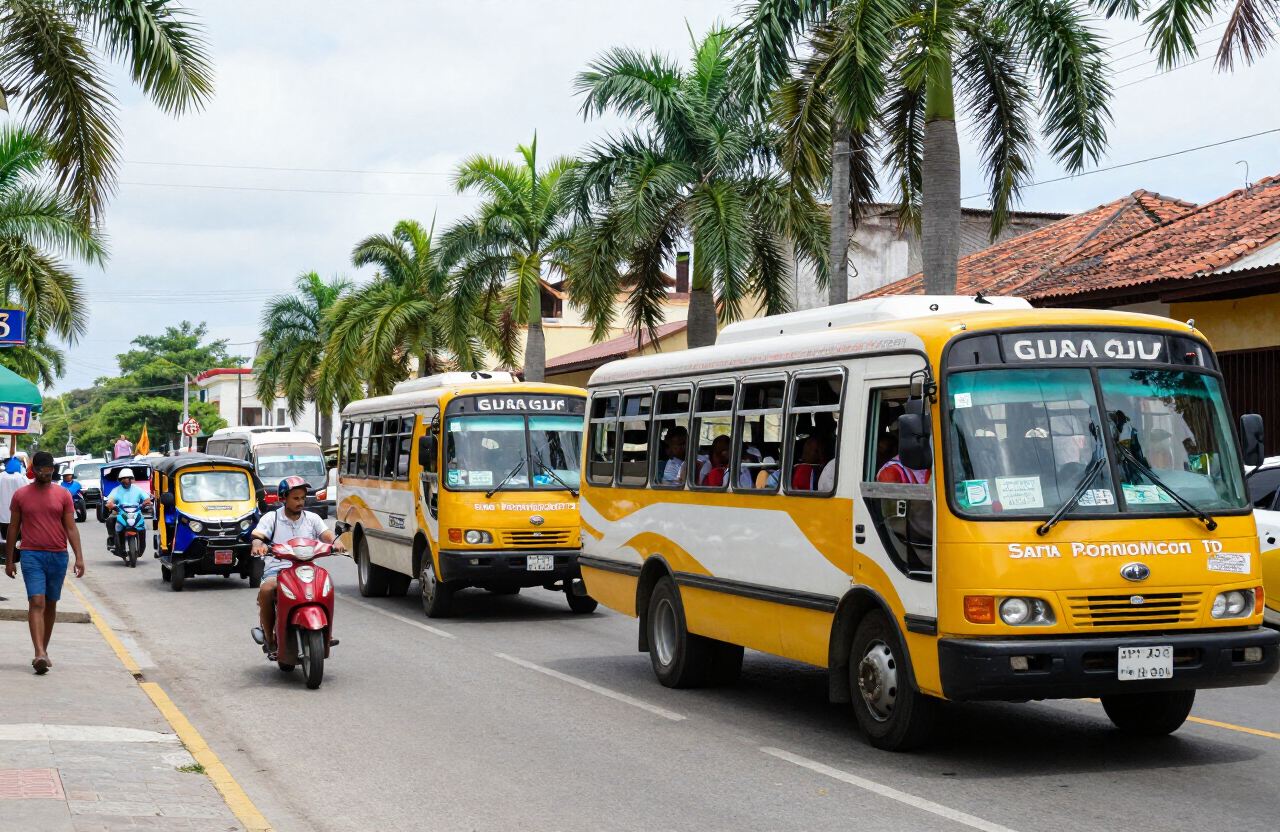
Despite the name, a guagua is not necessarily a bus. Depending on where you are, it can be a minivan, a small bus, or another type of shared vehicle that runs along a regular route.
There usually isn’t a formal bus stop the way you might be used to in the United States. Instead, you stand along the road and flag one down when you see the right one coming.
Once you get inside, you may be surprised by how many people can fit into what looks like a fairly small vehicle. The cobrador, or fare collector, will usually collect your money once you are on the road. If you are not sure what to pay, simply ask another passenger or tell the cobrador where you are going and they will tell you the fare.
Guaguas are inexpensive, practical, and often much faster than you might expect. They are especially useful for getting between towns where there is no need to rent a car.
Carritos públicos
Carritos públicos, usually just called carritos, are shared cars that operate on specific routes within cities and towns.
Think of them as a cross between a taxi and a bus. The driver picks up several passengers going in roughly the same direction, and everyone shares the cost of the ride.
You may get into a car that already has several people inside, and the driver will continue picking up passengers along the way. It is completely normal for someone to get in, someone else to get out a few minutes later, and another passenger to take their place.
The important thing to know is that carritos usually follow a specific route. If you are unfamiliar with the area, ask someone which carrito you need before getting in. You can simply say where you are going and ask, “¿Cuál carrito me lleva?”
Once you get used to them, they can be one of the easiest and cheapest ways to get around a city.
Motoconchos
Then there are the motoconchos.
A motoconcho is essentially a motorcycle taxi, and in many parts of the Dominican Republic, they are everywhere. They are particularly common in smaller towns and neighborhoods where a motorcycle can get you somewhere much faster than a car.
They are also incredibly useful for short distances, especially when traffic is bad or you need to get somewhere that is difficult for a larger vehicle to reach.
Always agree on the price before getting on. If you simply hop on without asking, you may end up having a conversation about the fare when you arrive.
Safety is important here, too. Motorcycle taxis are not the same experience as taking a regulated taxi or bus, and helmet use and traffic conditions can vary considerably depending on where you are. If you are not comfortable riding a motorcycle, do not feel pressured to take one just because it is the fastest option.
And if you do ride, hold onto the passenger handle or the designated part of the seat rather than the driver.
Intercity buses
For longer trips between major cities, you have more comfortable options.
Companies such as Caribe Tours and Metro operate intercity buses that connect destinations around the country. These are much closer to what you might think of as a traditional long-distance coach, with air conditioning, comfortable seats, and scheduled departures.
If you are traveling from Santo Domingo to another major city, taking an intercity bus can be a much easier option than trying to figure out a series of guaguas.
The buses are also a good choice if you are traveling with luggage or simply want a more predictable experience. Routes, schedules, and ticketing can vary, so it is worth checking the current information before you travel rather than assuming the schedule will be the same every day.
Taxis and ride apps
In larger cities and tourist areas, you will also find traditional taxis and ride-hailing services.
These are generally easier for visitors who are not familiar with the local transportation system, especially if you are carrying luggage or traveling late at night. In areas where ride apps operate, they can also make it easier to know your fare before starting the trip.
That said, taxis and private rides will obviously cost more than taking a guagua or carrito.
There is nothing wrong with using them. In fact, for some trips, they are the most practical choice. The trick is knowing when you actually need one.
How to know which one to take
The easiest way to think about Dominican public transportation is to choose based on the distance and where you are going.
For a short trip around town, a carrito or motoconcho may be the quickest option.
For traveling between nearby towns, a guagua is often the way to go.
For longer trips between major cities, an intercity bus is usually more comfortable and straightforward.
And if you are carrying luggage, traveling with a group, or simply do not feel comfortable navigating the local system, a taxi or private ride may be worth the extra money.
You also do not necessarily have to stick with one type of transportation for an entire trip. You might take a bus from Santo Domingo to a nearby city, catch a guagua to a smaller town, and then take a motoconcho for the last few minutes.
That is completely normal.
A few things to know before you ride
The biggest adjustment for visitors is that Dominican public transportation does not always operate with the level of structure you might be accustomed to.
Routes may not be clearly marked, stops may not be official, and drivers do not always follow a timetable that you can easily find online.
Ask questions.
Dominicans are generally very used to people asking which guagua, carrito, or bus they need. If you are standing somewhere and look confused, there is a good chance someone will tell you where to go.
It also helps to carry smaller bills and coins when possible. Having exact or close-to-exact change makes paying for inexpensive rides much easier.
And do not be surprised if the vehicle stops somewhere that does not look like a traditional bus stop. If you see people standing along the road waiting, there is a good chance they are waiting for transportation.
Once you understand the rhythm, it starts making sense.
Dominican public transportation may look confusing at first, but it is really just a system built around flexibility. People know their routes, they know where to wait, and they know how to get from one place to another without needing an app to tell them what to do.
For visitors willing to learn the basics, it can also be a great way to get beyond the resort areas and experience everyday Dominican life. You will see where people shop, work, eat, and live, and you may end up discovering parts of the country you would have completely missed from the back seat of a private shuttle.
Just remember the most important rule: when in doubt, ask someone. In the Dominican Republic, sometimes the person standing next to you on the corner knows exactly which guagua you need.